file system
file system is a software-based disk management
Its job is to transform massive, messy collection of physical disk blocks into abstractions (files, directories)
Defining characteristics
There exists many different implementation of file systems (since file system is purely a software it is much easier to introduce new implementations).
Even through different implementations (e.g. ZFS, XFS, AFS,…) some things remain constant:
- data structures (what types of on-disk structures are utilized by the file system to organize its data and metadata)
- access methods (how does FS map the calls made by a process, such as
open(),read(),write(), etc., onto its structures)
API
Since file-system is an abstraction, it provides an API (interface) to manage the underlying data, this interface is called file system interface
Typically used structures
To manage data, the files system needs to set aside specific areas of the physical disk for different purposes:
- data region
- the most of the disk (where actual contents of the files (arrays of bytes) are stored)
- inode table
- a dedicated space to store all the inode structures
- bitmaps
- simple structures that tell the OS which blocks are free or in use
- superblock
- master record
- contains metadata about the file system itself (e.g, how many inodes are there, where does the data region begins)
File system structure
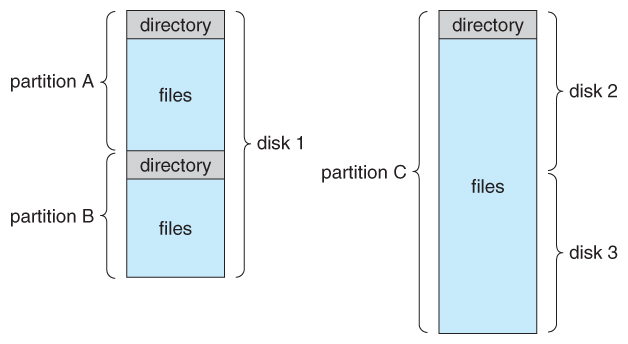
There are several ways to structure a disk as a file system:
- A disk can be used in its entirety for a file system
- A disk can be broken up into multiple partitions, each of which become a virtual disk and can have its own file system
- A multiple physical disks can be combined into one volume