UFO
UFO (Unified Foundational ontology) is a framework for defining common, domain-independent concepts that can be used to model specific domains in a structured way.
Key Parts of UFO:
- UFO-A (Endurants): Focuses on objects that persist through time.
- Example: A car or a person that exists over time.
- UFO-B (Perdurants): Focuses on events or processes that happen over time.
- Example: A meeting or a project that unfolds over time.
- UFO-C (Social Concepts): Deals with social entities like roles, agents, and agreements.
- Example: A contract between two parties or the role of a teacher.
Importance:
- UFO provides basic building blocks for modeling any domain.
- Ensures consistency and accuracy when representing real-world systems in software or information systems.
In short, UFO helps organize and describe entities, events, and social relationships in a way that applies across different fields or industries.
Example
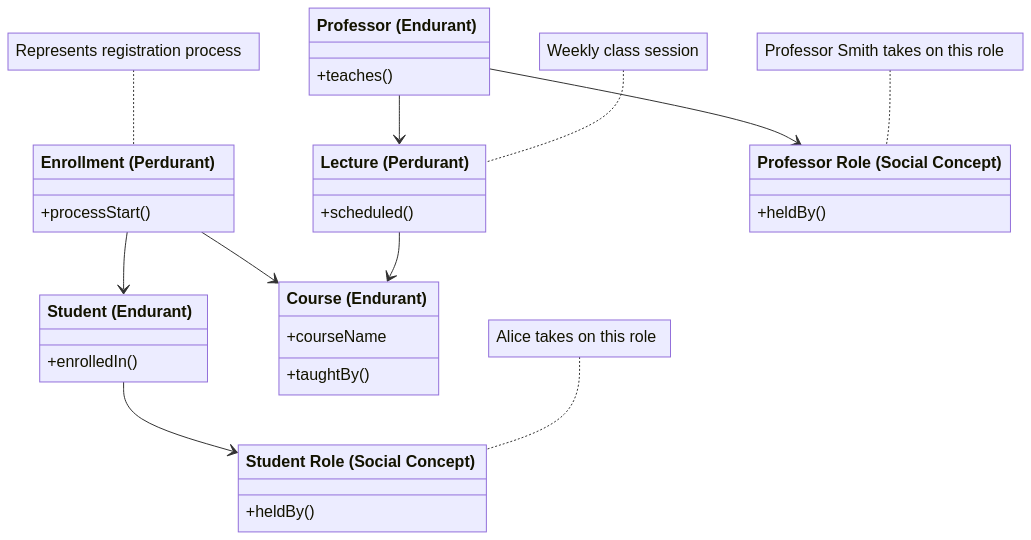
Here’s a simplified example of how UFO (Unified Foundational Ontology) can be applied in a conceptual model. Let’s say we’re modeling a university system:
Example 1: UFO-A (Endurants) – Objects That Exist Over Time
- Entities:
- Student (an object that persists over time, representing a person enrolled in the university)
- Course (an academic program that students enroll in)
- Professor (an object representing an individual who teaches courses)
Example:
- A student (Endurant) named Alice is enrolled in the university.
- A course (Endurant) like “Computer Science 101” is taught by a professor.
Example 2: UFO-B (Perdurants) – Events or Processes That Happen Over Time
- Processes:
- Enrollment (the process of a student registering for a course)
- Lecture (a class session held over time)
Example:
- The enrollment (Perdurant) of Alice in “Computer Science 101” happens at a specific time.
- A lecture (Perdurant) for the course is scheduled every week.
Example 3: UFO-C (Social Concepts) – Social Relationships, Roles, and Agreements
- Roles:
- Student Role (a person can take on this role within the university)
- Professor Role (a person takes this role when teaching courses)
Example:
- Alice plays the Student Role in the university system.
- Professor Smith takes on the Professor Role and teaches the course.
Putting it All Together:
- UFO-A (Endurants): Alice (Student), Professor Smith (Professor), and the course “Computer Science 101” (Course) are objects that exist over time.
- UFO-B (Perdurants): The enrollment process happens once for each student, while the lecture occurs weekly.
- UFO-C (Social Concepts): Alice takes on the Student Role, and Professor Smith holds the Professor Role in relation to the course.
This simple example shows how UFO helps structure knowledge by categorizing real-world entities, processes, and social relationships in a consistent way, making it easier to create accurate conceptual models.